
Researches Develop Mutant Gene-Targeted Immunotherapy
The novel immunotherapy approach uses bispecific antibodies against mutant proteins to target cancer cells
A novel targeted immunotherapy approach developed by researchers at the Ludwig Center, the Lustgarten Laboratory, and Bloomberg~Kimmel Institute for Cancer Immunotherapy at the Johns Hopkins Kimmel Cancer Center employs new antibodies against genetically altered proteins to target cancers.
The researchers targeted their immunotherapy approach to alterations in the common cancer-related p53 tumor suppressor gene, the RAS tumor-promoting oncogene, or T-cell receptor genes. They also tested the therapy on cancer cells in the laboratory and in animal tumor models. Their findings are reported in three related studies published March 1, 2021, in Science Immunology, Science, and Science Translational Medicine.
Two of the three research studies—led by Jacqueline Douglass, MD/PhD candidate at the Johns Hopkins University School of Medicine, and Emily Han-Chung Hsiue, MD, PhD, postdoctoral fellow at Johns Hopkins—report on a precision medicine immunotherapy approach that specifically kills cancer cells by targeting mutant protein fragments presented as antigens on the cancer cell surface.
Developing antibodies to target p53 and RAS mutations
Although common across cancer types, p53 mutations have not been successfully targeted with drugs. Genetic alterations in tumor suppressor genes often resulted in their functional inactivation.
"Traditional drugs are aimed at inhibiting proteins. Inhibiting an already inactivated tumor suppressor gene protein in cancer cells, therefore, is not a feasible approach,” says Hsiue, lead author on the Science paper.
Targeted drug therapies have been most successful against oncogenes, but most RAS gene mutations have been notoriously difficult to target. Instead of drugs, the researchers set out to target these gene alterations with newly-developed antibodies.
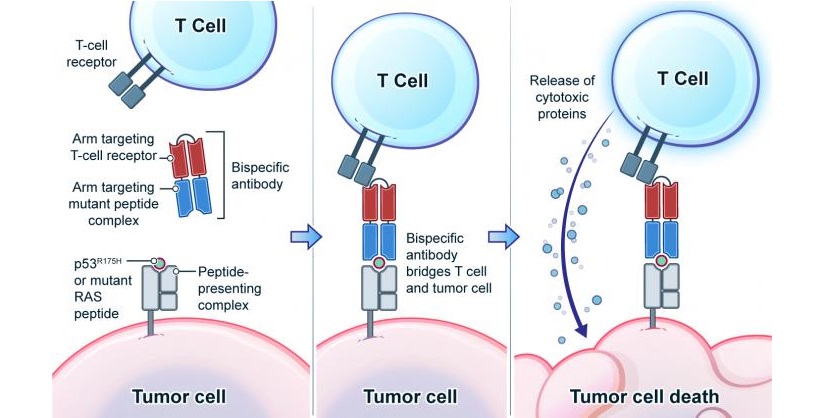
Conventional antibodies require an antigen target on the cell surface—most commonly a protein that looks like a foreign invader to the immune system. But the proteins produced by mutant oncogenes and tumor suppressor genes are inside the cells, out of reach by conventional antibodies. However, proteins are routinely degraded within cells, generating protein fragments called peptides.
"These peptides can be presented on the cell surface when complexed with the human leukocyte antigens (HLA) proteins," says Katharine Wright, postdoctoral fellow at the Johns Hopkins University School of Medicine and a lead author on the Science Immunology paper. "Mutated proteins in cancer cells can also be degraded and generate mutant peptides presented by the HLA molecules. These mutant peptide HLA complexes serve as antigens and mark cancer cells as foreign to the immune system."
The development of potent antibodies that specifically recognize the one amino acid difference between mutant proteins bound to HLA molecules is an extremely challenging task. To address this, the researchers used a five-step approach—combining state-of-the-art research technologies such as mass spectroscopy, genetics, and X-ray crystallography, which analyze cells at the molecular level—and immunologic techniques to develop a therapeutic strategy that targets these antigens.
They developed a therapeutic strategy in the form of bispecific antibodies, comprising one component that specifically recognizes cancer cells, and another component that recognizes immune cells and brings the cancer cells and immune cells together. In laboratory and animal tumor cell models, it resulted in the destruction of tumor cells.
"This therapeutic strategy is dependent on a cancer containing at least one p53 or RAS alteration and the patient having an HLA type that will bind to the mutant peptide to present it on the cell surface," says senior author Shibin Zhou, PhD, associate professor of oncology and director of experimental therapeutics for the Ludwig Center at Johns Hopkins.
Over the last five years, the researchers worked to overcome a variety of technical obstacles in an effort to develop antibodies that recognize only the mutant cancer gene fragments and not normal cells. To prove their antibody was specific to the mutant antigens, the researchers used CRISPR technology on cancer cells to change specific mutations in the target genes or disrupt the HLA type that is responsible for presenting the mutant peptides. The bispecific antibodies did not bring T cells to cancer cells when these genetic manipulations were made.
Treating T-cell cancers with bispecific antibodies
In the Science Translational Medicine paper, the researchers report that the powerful bispecific antibody approach they developed could also be used for the treatment of T-cell cancers. In animal models of T-cell cancers, the researchers showed that their approach selectively killed the cancerous T cells while sparing the majority of healthy T cells. Oncology fellow at Johns Hopkins University School of Medicine and lead author Suman Paul, MBBS, PhD, was inspired to perform this study while treating a patient with this type of cancer.
"The patient had skin lesions so painful that clothing was intolerable, and like other patients with this disease, had a dismal prognosis," says Paul, who emphasizes the need for better therapies.
"Immunotherapies against B cell lymphomas have worked well with therapeutic agents such as CAR T cells and bispecific antibodies that wipe out both healthy and malignant B cells. These B cell-targeting treatments are effective because humans can tolerate the loss of healthy B cells. But a treatment approach that depletes both healthy and cancerous T cells would not work in T-cell cancer patients, because the healthy T cells are necessary for a functioning human immune system. Wiping out the healthy T cells along with the cancerous T cells would essentially result in a disease like AIDS."
By targeting the cancer-associated T-cell receptors, the authors of the Science Translational Medicine study described a novel strategy that allowed killing of the cancerous T cells with loss of only a small fraction of healthy T cells.
Potential for a new form of off-the-shelf immunotherapy
Another type of immunotherapy, called checkpoint inhibition, works well in patients whose cancer has already drawn the attention of immune cells. Drugs called checkpoint inhibitors can successfully boost this immune response. Many cancers, such as pancreatic cancer and ovarian cancers, do not attract immune cells. However, these cancers very frequently contain RAS and/or p53 mutations, providing the opportunity for new forms of immunotherapy not dependent on natural immune responses, says Zhou.
The researchers say one of the major benefits of this type of immunotherapy is that it has the potential to work broadly across cancer types—as long as the patient has the mutant p53 or RAS gene and a matching HLA type, the therapeutic agent used should be relatively simple to produce.
"This is an off-the-shelf reagent, not a therapy requiring manipulation of individual patient's own T cells, so it's a much easier product from the manufacturing point of view. It could potentially be used for any patient who has the proper mutation and HLA type," says Sandra Gabelli, PhD, associate professor of medicine at the Johns Hopkins University School of Medicine and study coauthor.
The researchers say the next steps are to see if the strategy can be applied to other gene alterations in p53, KRAS, and other cancer driver genes.
"We intend to develop a large number of bispecific antibodies that would target such genes," says Alex Pearlman, MD/PhD student, and coauthor of the three studies. "Although any individual bispecific antibody would target a small fraction of cancer patients, a suite of antibodies would allow for the treatment of many patients."
The researchers are also concerned about off-target effects in which antibodies errantly bind to a similar target in a vital tissue or organ, a side effect that has been observed in other types of immunotherapies. Resistance to treatment is another concern the research team will study, as such resistance often occurs in patients treated with any therapy, including immunotherapy.
- This press release was originally published on the Johns Hopkins Medicine website