The field of commercially available sequencing instruments meeting in vitro diagnostic (IVD) regulatory requirements in the European Union has, until this week, been limited to a single platform category under the In Vitro Diagnostic Regulation (IVDR, Regulation (EU) 2017/746). Sequencing instruments supporting IVD workflows must carry European Conformity (CE) marking as Class A devices and be manufactured within an ISO 13485-certified quality management system.
Element Biosciences commercially launched AVITI Dx, its first CE-marked IVD sequencing platform under IVDR, in ten countries: the Netherlands, Germany, France, Italy, Spain, Austria, the Czech Republic, Latvia, Romania, and Poland. The launch adds a new IVDR-compliant sequencing option to the EU clinical market, with additional European and Asia-Pacific markets planned through a phased rollout. Clinical genomics lab directors now have a second CE-IVD platform to evaluate, making competitive tendering a viable strategy when making or renewing sequencing contracts.
AVITI Dx: ABC Chemistry Adapted for Regulated Clinical Workflows
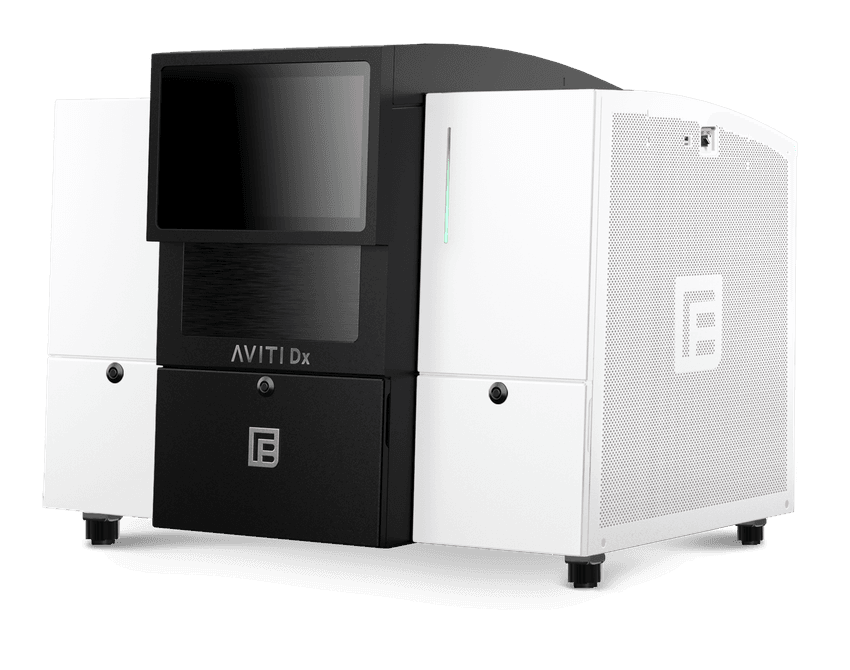
The AVITI Dx CE-IVD sequencing system from Element Biosciences, featuring dual flow cell architecture and dedicated IVD-mode operating software.
Element Biosciences
AVITI Dx runs on Avidite base chemistry (ABC), the same sequencing technology underlying Element Biosciences' AVITI research instrument line, adapted and documented under IVDR requirements. ABC uses rolling circle amplification (RCA) to generate polonies (clonal amplification clusters formed as concatemers of the library template) on the flow cell surface, then sequences them using multivalent avidite molecules binding through avidity-driven interactions. Element performs detection and extension steps separately, independently optimizing enzyme conditions for each step; a peer-reviewed BMC Genomics study found that for polymerase chain reaction (PCR)-free deoxyribonucleic acid (DNA) libraries, ABC showed 89.7% fewer errors than a leading short-read comparator on the research-use platform, though that finding does not constitute clinical validation data for AVITI Dx.
The instrument features two independently addressable flow cells, allowing IVD-mode and research use only (RUO) sequencing to run simultaneously without cross-contamination of regulatory workflows. Element describes this as a "dual-boot" design: dedicated reagents and software govern each mode, keeping IVD and RUO environments operationally separate. Labs supporting both regulated diagnostic testing and translational research, a common arrangement in academic medical centers, can serve both functions on a single instrument.
AVITI Dx Specifications: A Reference for Lab Evaluation Teams
The following specifications are drawn from the AVITI Dx product page and official spec sheet (LT-00075); all figures are manufacturer claims for IVD-mode operation and should serve as a starting point for site-specific verification.
Parameter
AVITI Dx
Regulatory
IVDR classification
Class A (non-sterile), self-declared per Article 48
CE marking status
CE mark (IVDR), October 2026
Quality management system
ISO 13485 certified, June 2026
Performance
IVD-mode read lengths
2x150 bp (high and low output); 2x75 bp (high output)
Q30 accuracy
Greater than or equal to 90 percent across all IVD kits (manufacturer specification)
Read count, high-output kits (2x150 and 2x75)
Greater than or equal to 1.2 billion reads per flow cell
Read count, low-output kit (2x150)
Greater than or equal to 300 million reads per flow cell
Run time, 2x150 kits
Less than or equal to 40 hours
Run time, 2x75 kit
Less than or equal to 26 hours
Operations
Flow cell architecture
Dual independent flow cells, two addressable lanes each
Operating environment
18°C to 26°C; less than or equal to 2000 m elevation
IVD/RUO dual-mode operation
Yes; dedicated kits and software per mode; kits not cross-compatible
Does IVDR Class A Cover the Full Diagnostic Sequencing Workflow?
IVDR Class A applies to non-critical laboratory components whose output does not directly determine a patient diagnostic result, including sequencing instruments, accessory software, and universal reagents. Under IVDR Article 48, Class A non-sterile devices can be self-declared by the manufacturer, bypassing notified body review, provided three documentation obligations are met:
General Safety and Performance Requirements (GSPR): Demonstrate compliance with Annex I of IVDR, which sets out the safety and performance criteria the device must satisfy
Technical documentation: Maintain complete Annex II documentation, including device description, design, manufacturing information, and post-market performance data
Post-market surveillance plan: Produce an Annex III post-market surveillance plan defining how the manufacturer will monitor device safety and performance after market entry
The IVDR replaced the In Vitro Diagnostic Directive (IVDD 98/79/EC) in May 2022, introducing a stricter, risk-based classification system that significantly expanded the documentation burden for IVD manufacturers compared to its predecessor.
Element Biosciences received ISO 13485 certification in June 2026 and manufactures AVITI Dx under that system; per its stated intended use, the platform generates raw DNA sequencing data only and does not provide diagnostic interpretations or clinical recommendations. Class A status covers the instrument, its IVD-labeled reagents, and associated software, but does not extend to the diagnostic assay panels run on it. Oncology panels, prenatal screening assays, and rare disease gene panels typically carry Class B, C, or D classification under IVDR depending on intended use, each requiring its own conformity assessment.
"Launching AVITI Dx across ten EU markets reflects years of investment in the quality systems, manufacturing capabilities, and global supply chain needed to support regulated clinical markets," said Jeff Labbadia, Chief Supply Chain Officer at Element Biosciences. "Our ISO 13485-certified quality management system and established manufacturing controls provide the foundation for delivering an integrated sequencing platform with the consistency, traceability, and reliability that clinical laboratories expect."
In-House Tests Add a Second Compliance Layer
Labs planning to build and validate their own sequencing panels face additional obligations under IVDR Article 5(5), which governs in-house developed tests (IH-IVDs). IH-IVDs are the EU equivalent of laboratory developed tests (LDTs) under the US Clinical Laboratory Improvement Amendments (CLIA) framework; Article 5(5) requires labs to meet IVDR General Safety and Performance Requirements, maintain an ISO 15189-compliant quality management system, and by May 2028, document why no commercially available equivalent exists. Labs running third-party IVDR-cleared kits on AVITI Dx face a substantially simpler compliance path.
AVITI Dx Launches Without Cleared Assay Panels
No IVDR-cleared diagnostic assay panels are available on AVITI Dx at launch, and no peer-reviewed clinical validation study for AVITI Dx in an IVDR-compliant laboratory setting has been published. Element Biosciences is co-developing an IVD neonatal workflow with Revvity targeting newborn screening applications, announced in January 2025, but that collaboration had not reached IVDR clearance at the time of this article. Labs requiring a cleared panel, or whose accreditation requirements call for external validation data before adoption, should factor both gaps into evaluation timelines.
Steps EU Labs Must Complete Before IVD Deployment
Five compliance and operational steps must be completed before AVITI Dx can support regulated diagnostic testing in a clinical lab.
Regulatory documentation: Obtain the EU Declaration of Conformity and Annex II technical documentation for AVITI Dx and each associated IVD-labeled reagent kit and software module.
Assay IVDR status: Confirm the IVDR classification and CE marking status of every panel intended for IVD-mode use; for in-house panels, review Article 5(5) obligations and document justification for use over commercial equivalents by May 2028.
IVD/RUO mode controls: Establish standard operating procedures (SOPs) documenting separation between IVD-mode and RUO-mode runs to satisfy IVDR traceability and post-market surveillance requirements.
Accreditation notification: Notify the accreditation body of the instrument change and submit updated quality documentation, including equipment qualification records, method verification or validation data, and revised SOPs, before diagnostic use begins.
On-site performance verification: Complete a site-specific verification study covering precision, accuracy, carryover, and interference before clinical use, regardless of the manufacturer's Class A self-declaration.
AVITI Dx Enters a Growing but Compliance-Intensive EU Sequencing Market
AVITI Dx enters the EU IVD NGS market as a CE-marked, IVDR Class A platform built on a chemically distinct sequencing architecture, expanding lab procurement choices in a space where regulatory barriers have historically kept options limited. Its RCA-based, PCR-free sequencing architecture distinguishes it technically, but real constraints remain at launch: no IVDR-cleared assay panels and no published clinical validation data for the IVD configuration. EU clinical genomics lab directors now have a substantive new platform to evaluate alongside established CE-IVD options, making competitive tendering a viable procurement strategy for the first time in this instrument category.
This article was created with the assistance of Generative AI and has undergone editorial review before publishing.
Add Today's Clinical Lab as a preferred Google source to see more of our trusted coverage.
Sharon Dong, MSc, BSc (Hons), joined LabX Media Group (LMG) in 2026 as a Product News & Intelligence Editor. She has a background in cellular biology, microbiology, immunology, and molecular genetics. She is an experienced science education and outreach facilitator. Sharon is passionate about communicating science in ways that are clear, engaging, and accessible to a broad audience. In her free time, she enjoys solving jigsaw puzzles and cooking. Sharon can be reached at sdong@labxmediagroup.com.