The clinical laboratory plays a critical role in the delivery of healthcare, performing an integral function in the
diagnostic and clinical decision process. It is a function that is rapidly growing in complexity. Today, there are
more than 4,000 types of laboratory tests available; roughly 500 of these tests are ordered on a consistent basis.
This trend of increasing complexity and volume will continue as genetic testing and personalized medicine advance.
Similarly, technology and infrastructure will continue to impact the functionality and design of the clinical
laboratory. Emerging design approaches will improve specimen processing, optimize space allocation, and encourage
healthy work environments.
Improving specimen processing
Specimen processing is one of the most critical elements of lab workflow as it relates to turnaround time and critical
efficiencies. The rapid reporting of laboratory test results is imperative to quickly and accurately diagnose and
treat patients. Over the last decade, labs have steadily progressed from manual to automated testing. Efficiencies are
found in point-of-care devices and hand-held technology, outpatient specimen collection stations, courier pick-up and
drop-offs, LIMS software, automated analysis including robotic tracks, and pneumatic tube systems.
To continue reading this article, sign up for FREE
Membership is FREE and provides you with instant access to eNewsletters, digital publications, article archives, and more.
Steve Hackman is a principal and leader within SmithGroup's Science and Technology practice who supports clients in the strategic design of laboratories. He can be reached via email at steve.hackman@smithgroup.com View Full Profile
Joyce Durham has focused her career on clinical, operational, and facility planning for healthcare facilities. As a registered nurse and registered architect, Joyce's passion is healthcare facilities that reflect the most efficient, effective, and compassionate delivery of care.View Full Profile
The clinical laboratory plays a critical role in the delivery of healthcare, performing an integral function in the
diagnostic and clinical decision process. It is a function that is rapidly growing in complexity. Today, there are
more than 4,000 types of laboratory tests available; roughly 500 of these tests are ordered on a consistent basis.
This trend of increasing complexity and volume will continue as genetic testing and personalized medicine advance.
Similarly, technology and infrastructure will continue to impact the functionality and design of the clinical
laboratory. Emerging design approaches will improve specimen processing, optimize space allocation, and encourage
healthy work environments.
Improving specimen processing
Specimen processing is one of the most critical elements of lab workflow as it relates to turnaround time and critical
efficiencies. The rapid reporting of laboratory test results is imperative to quickly and accurately diagnose and
treat patients. Over the last decade, labs have steadily progressed from manual to automated testing. Efficiencies are
found in point-of-care devices and hand-held technology, outpatient specimen collection stations, courier pick-up and
drop-offs, LIMS software, automated analysis including robotic tracks, and pneumatic tube systems.
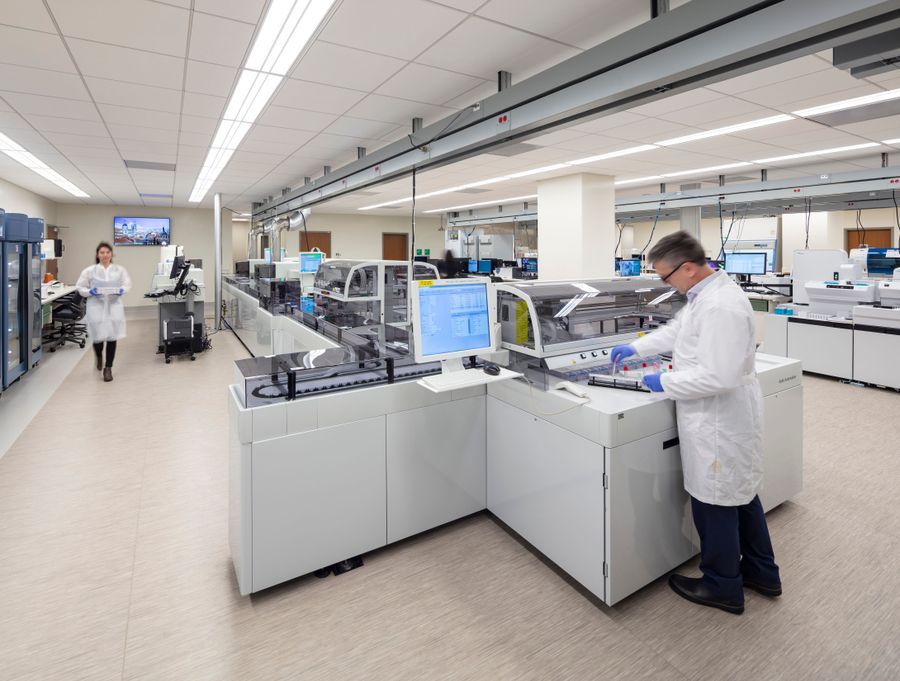
Automated line at Sutter Health California Pacific Medical Center, Van Ness Campus Hospital, San Francisco,
California.
Kyle Jeffers, Courtesy of SmithGroup
Lean methodologies of continuous improvement in processing, quality, and service have been increasingly implemented in
numerous clinical lab projects, particularly in recent years as the increase in test volumes and the decrease of
technical staff drives the need for higher efficiencies in lab operations and design. An understanding of the supply
chain and lab business model is key to planning with Lean methodologies and design principles, as clinical
administrators and laboratory planners work together to apply their experience to inform lab operations.
The application of Lean concepts streamlines specimen flow and reduces staffing costs through improved efficiencies.
The design of the laboratory can respond to these demands by optimizing space to promote the following:
Continuous flow of specimens as opposed to batching
Open areas that provide flexibility for assignment and management
Inventory systems that allow visual monitoring, reducing consumables
Robotic tracks that connect analyzers to minimize hand carrying of specimens
Work benches with multiple adaptations to achieve a balanced workload
Unobstructed linear flow to increase staff efficiency, especially on night shifts
Adequate equipment space with access for servicing and proper air flows
Optimizing space allocation
While the optimization of specimen processing is the central focus within most clinical laboratories, crucial
decisions must be made regarding the lab’s physical location in the organization of the hospital, the planning
of surrounding areas, and consideration of other critical adjacencies and relationships. Space is expensive and a
precious commodity in the acute care setting. Therefore, many organizations are rethinking how and where to locate
laboratory space, which may include these considerations:
Core labs: Traditionally located on-site within the hospital, ‘core’ reference
labs have proximity to patients and pathologists, but also occupy premium space and expensive real estate.
Rapid response labs: Being located on-site in the acute care hospital supports the need for tests
requiring immediate or rapid (four-hour) turnaround capacity.
System wide reference labs: These labs are located in a centralized location off-site to process
longer, less time-sensitive testing. An emerging trend of co-locating facilities for clinical labs, diagnostics, and
research has revolutionized many organizations and takes advantage of current technologies, consolidation of testing
services, and optimization of high-volume throughput.
Each of these considerations for the clinical lab location is complex and affected by existing space constraints, high
construction costs, real estate costs, and perceptions about the appropriate proximity of the core lab.
Increased automation may result in higher sample volume, and consequently, greater demand on the facility and staff.
Supply needs may increase along with the need for controlled-temperature specimen storage, pneumatic tube systems, and
the operational management of materials.
From the accessioning of samples to the final delivery of test results, critical pathways can be enhanced by proper
laboratory planning to allow for improvements in time-sensitive workflows, advances in instrumentation, and changes to
the core scientific basis for various testing methodologies. To accommodate these operational needs, the physical
environment of the clinical laboratory should be designed from the inside-out as a flexible facility with the
following characteristics:
Open labs with ceiling-mounted plug-and-play services
Modular utilities distribution
Movable and reconfigurable casework
Uniformly located plumbing, including sinks and floor drains
Ubiquitous data to support digital technologies
Assigned R&D/growth space for emerging scientific needs
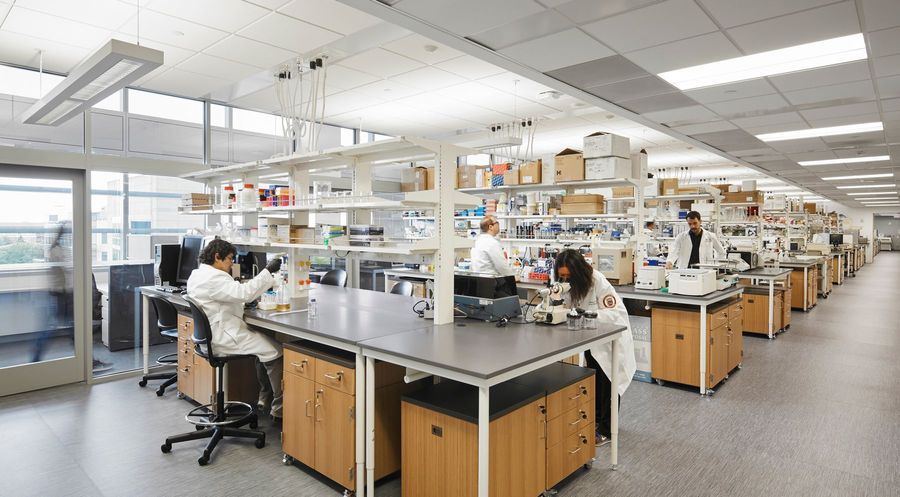
Open laboratory at Loyola Medical Center (CTRB), Maywood, Illinois.
Dave Burk, Courtesy of SmithGroup.
In order to create the flexibility needed in today’s clinical laboratories, design principles such as open
planning and modular design have been successfully implemented. An open floor plan enhances the laboratory’s
ability to expand and modify workflows and functionalities over time. Open labs support an increase in test volumes,
allow an easier reconfiguration of space, and support technological advances in instrumentation.
Modular design enables future flexibility while establishing uniformity, consistency, and familiarity. The clinical
laboratory’s unique workflows and instrument needs dictate a specialized approach, with multi-directional and
often diverse module sizes that prevent overcrowding and congestion in the lab while improving safety, performance,
and efficiency.
Encouraging healthy work environments
Existing laboratory space has historically neglected the human and intellectual needs of the technicians, scientists,
and staff in favor of the needs of the equipment. Large, windowless laboratories with few or no amenities to support
collegial interaction have characterized these facilities. The design of new or renovated clinical laboratories can
bring fresh thinking to improve work life and can provide stimulating environments that encourage interaction.
Creating environments that enhance the quality of life and wellness of lab users is one of the highest priorities in
designing clinical laboratories today. While traditional ergonomic considerations remain critically important, the
following more holistic strategies can enhance the workplace:
Automation decreases repetitive motion disorders and increases staff efficiency
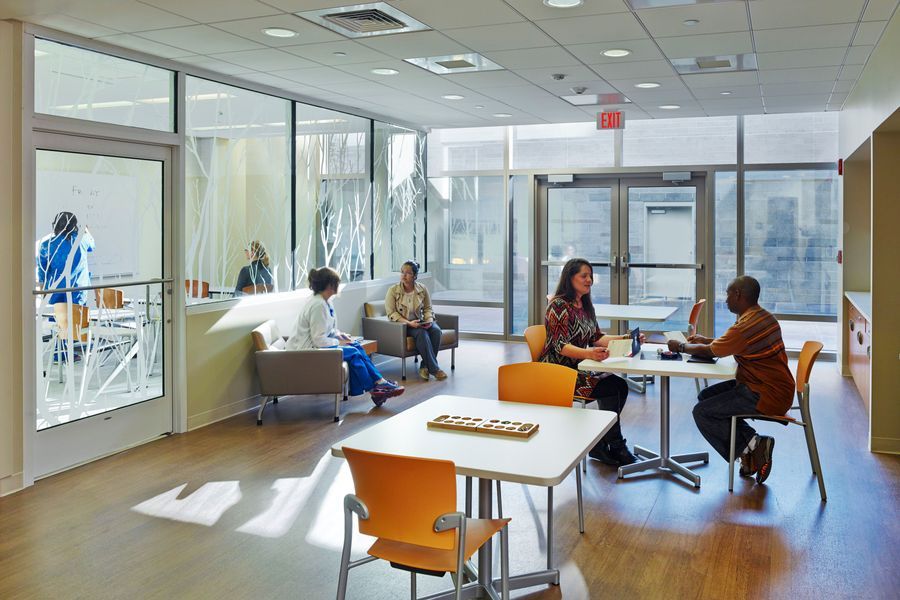
Shared interaction spaces promote teamwork, trust, and collaboration
Sound-attenuation materials reduce noise levels
Natural light, color, and artwork create comfortable, human-centric environments
Adjustable light levels accommodate a range of tasks
Proper safety/containment strategies reduce exposure to hazards
Adjustable workstations accommodate a range of user preferences
Staff break rooms with views enhance collaboration
In addition to staff workflow and safe protocols, the facility’s mechanical, electrical, and plumbing systems
provide a high level of security and comfort for the occupants and for the personnel who operate and maintain the
systems. Specific goals for the safe integration of lab systems for clinical testing and research include:
Flexibility of systems reconfiguration
Control of lab exhaust and room pressurization
Energy conservation measures
System redundancy
System maintenance and lifecycle
Safe practices in the laboratory rely on the appropriate design and application of industry standards and regulations.
Best practices are drawn from technical experience, industry participation, and reference to documents such as the
CLSI Laboratory Design: Approved Guideline, the CDC-NIH Biosafety in Microbiological and Biomedical Laboratories
(BMBL), and the SEFA Recommended Practices for Scientific Equipment, Laboratory Casework, and Fume Hoods.
An understanding of how a clinical laboratory functions and operates is critical to planning and designing an optimal
laboratory environment. Among the key clinical lab design principles are workflow efficiency for improved specimen
processing; flexible and modular space allocation to accommodate robotic instrumentation; and safe, people-centric
design to promote healthy work environments. With the myriad of issues and options in the workplace, the clinical
laboratory planner can facilitate a discussion of what’s ailing your laboratory in order to find optimal
solutions that fit your specific needs.