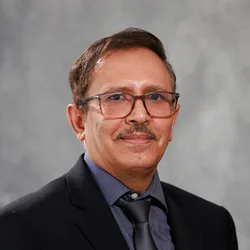
Ali Gabali, MD, PhD, chief medical director of pathology and laboratory at McLaren Health Care
Credit: Ali Gabali, MD, PhD
Ali Gabali, MD, PhD, is the chief medical director of pathology and laboratory at McLaren Health Care. A physician-scientist with more than 20 years of experience, he has helped develop McLaren’s internal pathology group and expand access to subspecialty expertise. Today’s Clinical Lab spoke with Gabali about the operational changes behind the technology and where he sees its greatest value.
Q: What challenges led you to pursue digital pathology at McLaren?
A: We have 13 hospitals, and some are six or seven hours away from one another. When I was asked to establish a new pathology department, I knew recruitment would be difficult without digital pathology.
There is also the challenge of working in a hospital with only one or two pathologists. If a colleague is away, the remaining pathologist still has to sign out cases, including difficult ones. Digital pathology makes it easier to ask another pathologist to review a case when you need help. That support strengthens your confidence in the diagnosis.
The value goes beyond having an image on a monitor. It is the ability to bring people together around a case, regardless of where they are working.
Q: How has it changed the daily work of reviewing and sharing cases?
A: Previously, we relied on couriers to move slides between hospitals and the core laboratory. Some cases would not arrive until the afternoon. Now, pathologists can access cases as soon as the slides are scanned. We can also redistribute work much more easily. If I have 30 cases but can only finish 10, we can assign the remaining cases to colleagues without transporting the glass slides. Those colleagues may be hours away.
Reviewing slides is different, too. Under a microscope, you take each slide from the tray, place it on the stage, focus, and sometimes mark an area before comparing it with another slide. Digitally, I can annotate an area of interest, orient the image, and move between slides quickly. When I ask a colleague for an opinion, I can direct them to the area I have marked. In a laboratory producing thousands of slides a day, that time matters.
Q: What difference has easier access to colleagues made for collaboration?
A: We hold a daily, hour-long consensus conference where our pathologists share difficult cases. Everyone can look at the same case and discuss it without passing slides from one location to another. A pathologist does not have to work through a challenging diagnosis alone.
Digital pathology has also helped us organize around subspecialties. When I recruited the group, I selected people with different areas of expertise. We now have panels for areas such as gastrointestinal pathology, brain tumors, and lymphoma and leukemia. Pathologists develop that expertise through exposure to cases and interaction with experienced colleagues. Being able to share cases digitally supports those interactions across the health system.
Q: How does digital pathology support recruitment and hospital coverage?
A: Flexibility has been very appealing to recruits. Our pathologists can work from home for up to three days a week, and they have more flexibility when they review their cases. One of our pathologists typically starts at 10 p.m., so we plan the scanning schedule around that. We have also been able to schedule two pathologists to cover after-hours across 13 hospitals. A trained grossing technician or pathologists’ assistant prepares the section and places the slide in the scanner. The pathologist can then review it from home, even if the hospital is several hours away.
If the case requires another opinion, a colleague can open it remotely as well. That combination of coverage and access to expertise makes a substantial difference to how we organize the service.
Q: Where have you seen financial benefits from the implementation?
A: The savings come from several parts of the workflow. With colleagues available to review difficult cases internally, we have reduced our reliance on outside consultations. We also spend less moving glass slides between locations.
Preparing for digital pathology prompted us to examine how many slides we needed for different types of cases. We brought pathologists together to determine the minimum number that would support a diagnosis without compromising it. Reducing unnecessary slides means less scanning time and lower spending on slides, labels, and printing supplies. It also reduces the amount of physical storage we need.
There are smaller costs that are easy to overlook. A slide broken during transport may require another section and repeat staining, adding expense and delaying the case.
These benefits depend on the work behind the implementation. You have to plan the infrastructure, validate the system, and organize how slides move through the laboratory. Buying a scanner is only one part of that process.
Q: Where do you see the greatest opportunities for digital pathology next?
A: Digital pathology opens the door to using artificial intelligence in our workflow. One opportunity is supporting more consistent scoring of immunostains, where interpretations can vary between observers. Another is triage. In the future, AI could help identify cases that may need urgent attention so we can prioritize them, rather than simply working through a queue in order. It could also help us spend more time on complex cases and less time reviewing routine findings.
I can imagine a system eventually flagging a case for consensus review and making it available to the whole group. For me, the opportunity is to strengthen the pathologist’s work by making it easier to focus attention where it is needed and bring in colleagues when their expertise can help.
Learn more about Roche's digital pathology platform: https://diagnostics.roche.com/us/en/products/product-category/lab-type/pathology-lab/digital-pathology.html